Algorithmic Complexity
Read at your own pace. Code execution, quizzes, progress tracking, and the AI tutor are available in the interactive view with JavaScript enabled.
Your Final Lens
Algorithmic Complexity, Revisited
You have now touched the major interview tools: arrays, hash tables, stacks, queues, linked lists, trees, graphs, recursion, dynamic programming, greedy algorithms, and even mock interview communication.
This final lesson ties them together through one question:
How does my solution behave as the input grows?
In Time and Space Complexity Analysis, you learned the Big O basics. Here, we will use complexity as an interview decision-making tool: comparing approaches, spotting hidden costs, and explaining tradeoffs clearly.
For firms like Jane Street, interviewers care less about memorizing labels and more about whether you can reason precisely under constraints.

Complexity Is Budget
Complexity Is a Budget
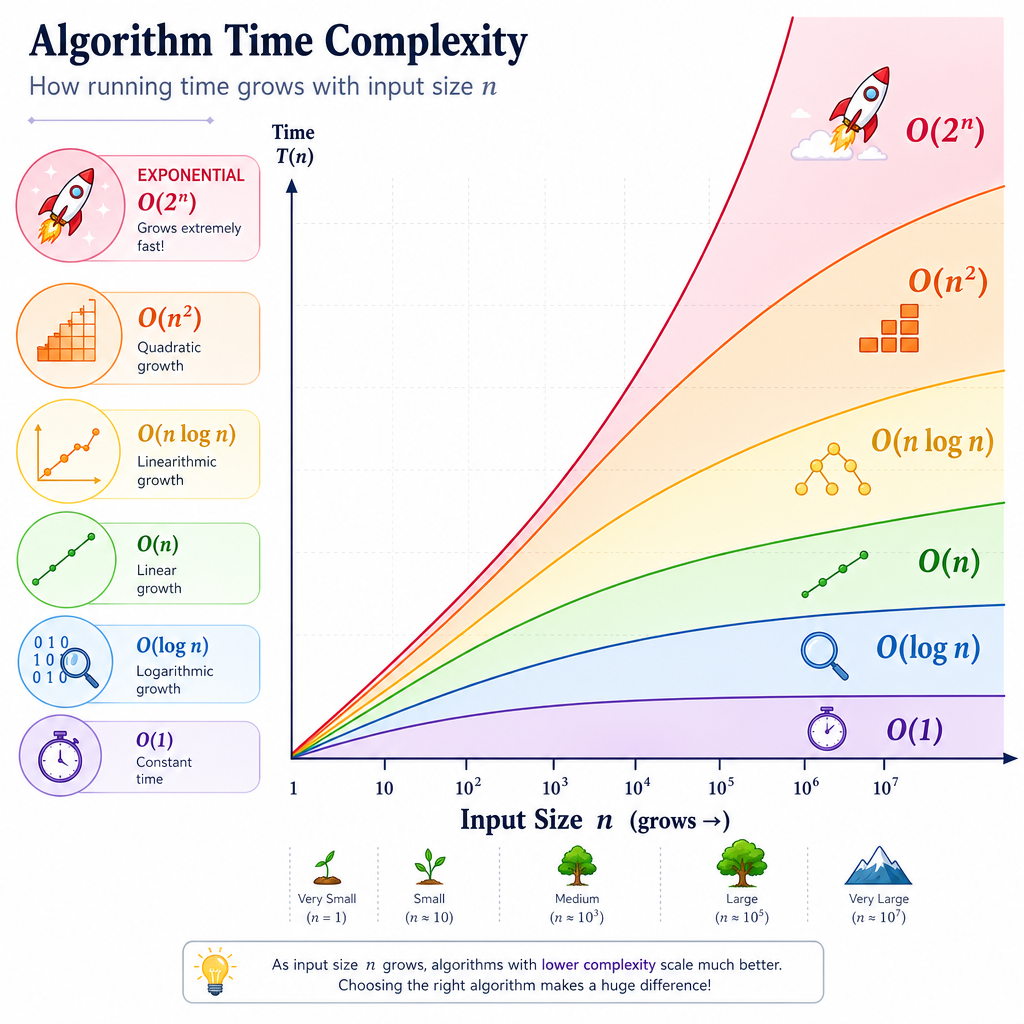
Think of complexity as a rough budget for runtime and memory.
If n = 100, many approaches work. If n = 10,000,000, the wrong complexity can make the program unusable.
A useful interview habit:
- Ask about input size.
- Estimate what complexity is acceptable.
- Pick the simplest approach that fits.
- Explain the tradeoff.
A rough mental guide:
Input size Often acceptablen <= 20
exponential/backtracking may be okay
n <= 1,000
O(n^2) may be okay
n <= 100,000
usually aim for O(n log n) or O(n)
millions+
usually need O(n), O(log n), or streaming
This is not a law. It is a judgment tool.
Variables Matter
Not Everything Is Just n
In real interview problems, there may be multiple input sizes.
For example:
-
ntrades -
maccounts -
ksymbols -
Vvertices andEedges in a graph
Do not collapse everything into O(n) if there are two independent inputs.
If you compare every trade to every account, that is likely O(n * m), not simply O(n^2) unless n and m are known to be similar.
This matters in finance-style data problems because one dimension may be small while another is huge.
```python
# Count comparisons when two input sizes are independent.

trades = ["T1", "T2", "T3"]
accounts = ["A1", "A2", "A3", "A4"]

checks = 0
for trade in trades:
    for account in accounts:
        checks += 1

print("trades:", len(trades))
print("accounts:", len(accounts))
print("comparisons:", checks)
print("complexity shape: O(n * m)")
```
Spot The Complexity
You have n trades and m accounts.
For every trade, your code scans every account once.
What is the most precise time complexity?
Slice Cost Check
True or false:
Inside a loop, repeatedly doing arr = arr[1:] can turn a seemingly simple loop into a more expensive algorithm because each slice copies elements.
Amortized Thinking
Amortized Complexity
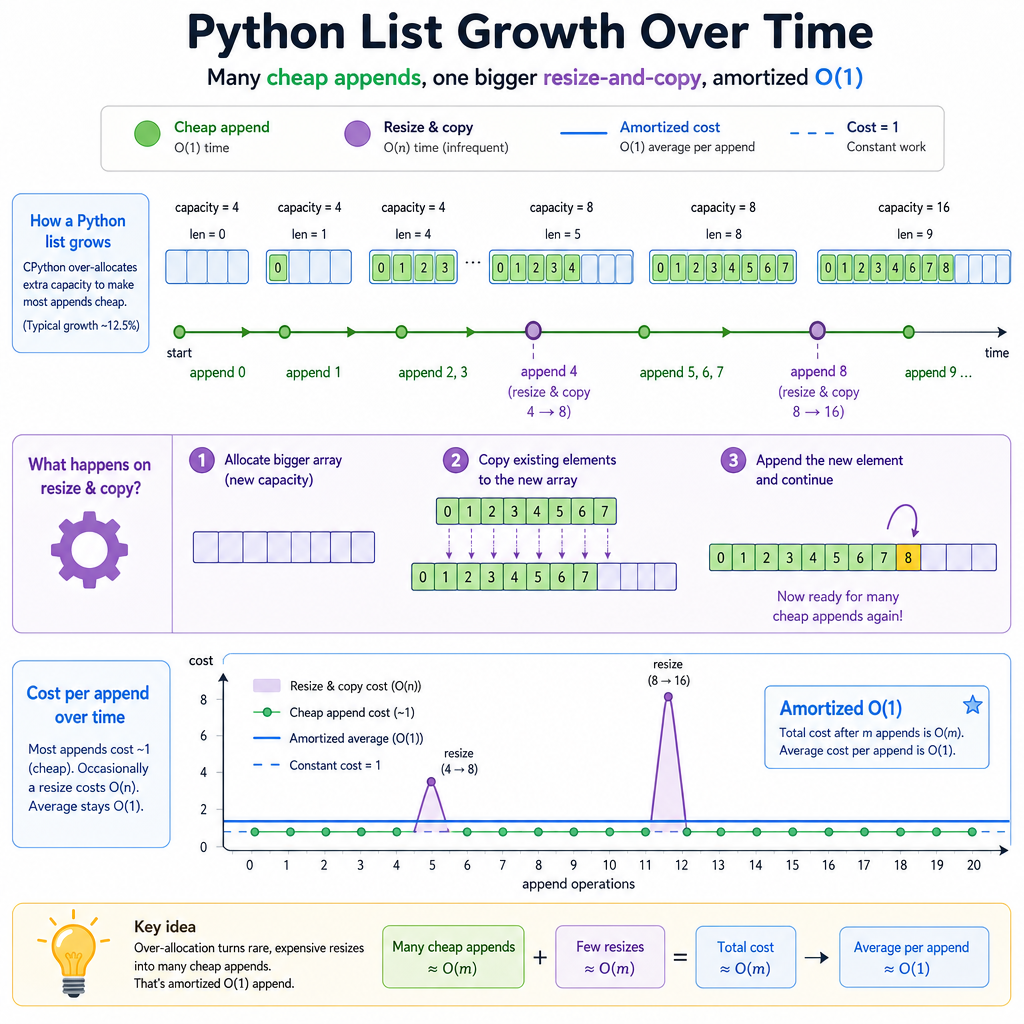
Sometimes an operation is usually cheap but occasionally expensive.
Python list append is the classic example. Most appends are fast. Occasionally, the list needs to resize internally and copy elements to a larger memory area.
Instead of saying every append is always O(1) in the strictest sense, we usually say:
list.append(x)is amortized O(1).
That means over many appends, the average cost per append is constant.
This is useful interview language. It shows you understand both the practical behavior and the underlying tradeoff.
Fill The Term
An operation that is usually constant time but occasionally does extra resizing work, while still averaging constant time across many operations, is described as ________ O(1).
Tradeoff Playbook
Complexity Tradeoff Playbook
By now, you have seen the same tradeoffs appear across many lessons.
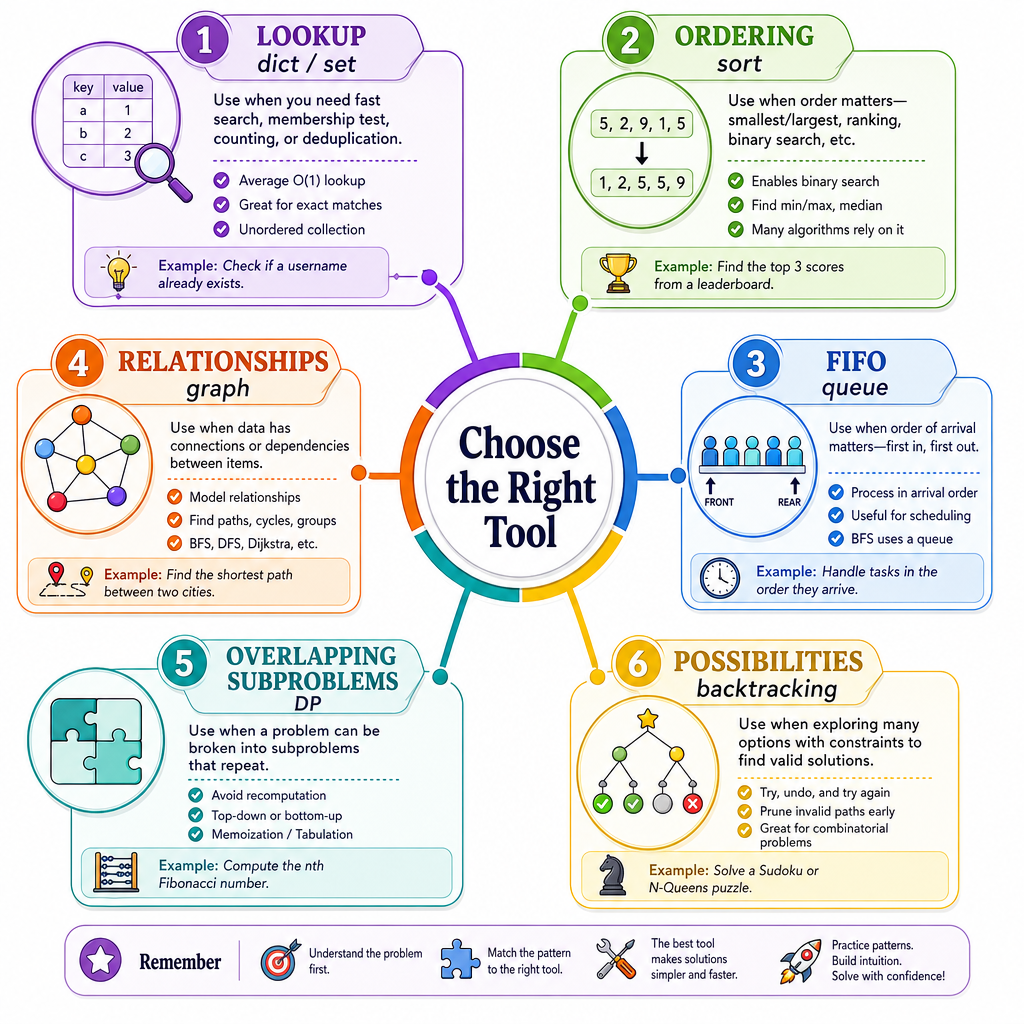
Use this checklist when choosing an approach:
-
Need fast lookup? Consider a
setordictfrom Hashing and Hash Tables. - Need order? Arrays, sorting, heaps, or balanced tree ideas may matter.
- Need first-in-first-out behavior? Use a queue from Stacks and Queues.
- Need explore relationships? Model it as a graph and use BFS/DFS from Graphs.
- Need optimal choices over overlapping subproblems? Consider DP from Dynamic Programming.
- Need generate possibilities? Use recursion/backtracking, but estimate the search tree.
A strong interview answer is rarely just: “This is O(n).”
A stronger answer is:
“This is
O(n)time andO(n)space because I use a set to avoid theO(n^2)nested scan.”
Final Complexity Capstone
Capstone: Explain the Upgrade
Suppose you receive a stream of trade IDs and need to detect duplicates.
A beginner solution might compare each new ID to all IDs seen so far. That can become O(n^2).
A better interview solution uses a set:
- Time:
O(n)average - Space:
O(n) - Reason: each trade ID is stored once, and lookup is average constant time
This final step is the heart of algorithmic complexity: not just naming Big O, but using it to justify design choices.
As you continue practicing mock interviews, keep this loop:
- Clarify constraints.
- Start with a correct simple approach.
- Analyze complexity.
- Improve the bottleneck.
- Explain the tradeoff clearly.
That loop connects everything you learned in First step.
```python
# Duplicate trade ID detection using a set.

trade_ids = [101, 205, 309, 101, 412, 205]
seen = set()
duplicates = []

for trade_id in trade_ids:
    if trade_id in seen:
        duplicates.append(trade_id)
    else:
        seen.add(trade_id)

print("trade ids:", trade_ids)
print("duplicates:", duplicates)
print("time complexity: O(n) average")
print("space complexity: O(n)")
```