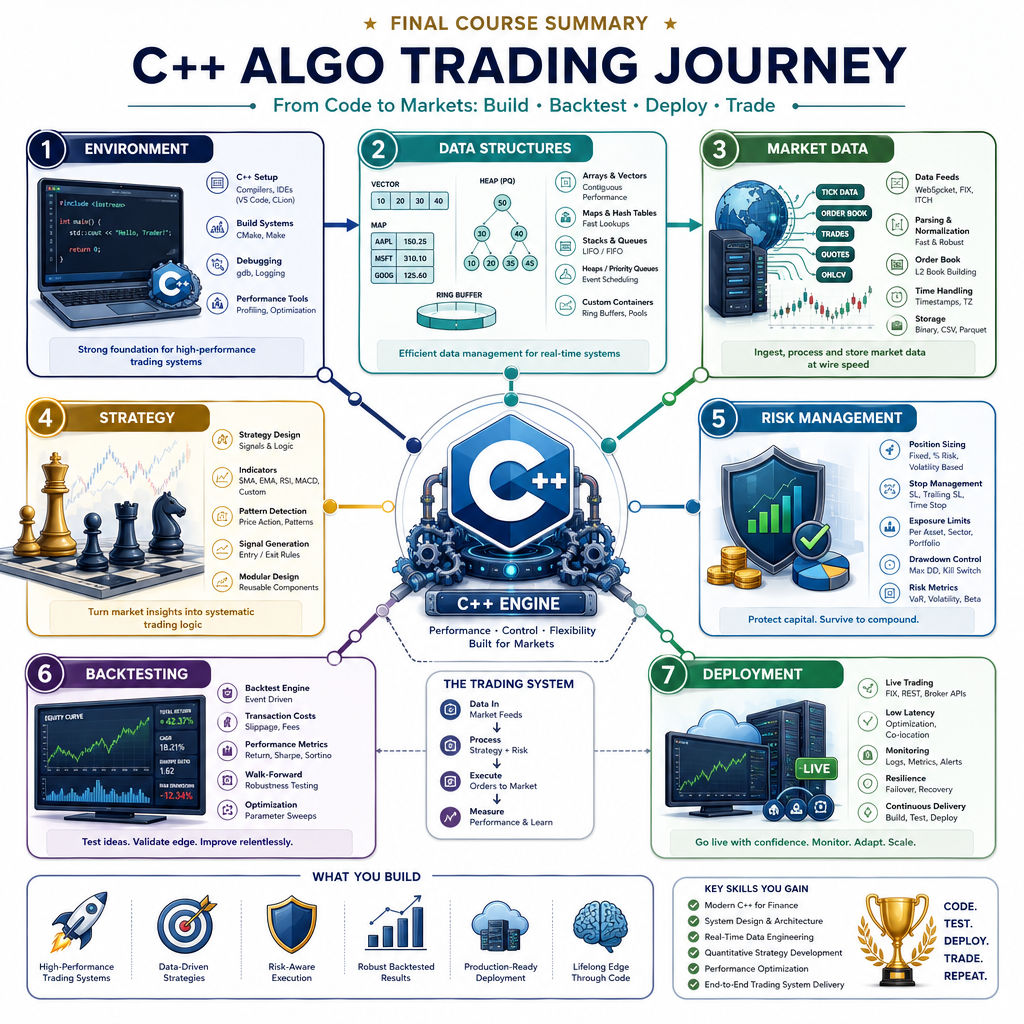
Deploying Your Trading Application
Read at your own pace. Code execution, quizzes, progress tracking, and the AI tutor are available in the interactive view with JavaScript enabled.
From Backtest To Deployment
The final step: safely going live
Now that you've completed Backtesting and Strategy Optimization, you have a strategy that can be measured instead of guessed.
Deployment is where your C++ trading application becomes a real service:
- It starts reliably
- Loads the correct configuration
- Connects to market data and broker/order gateways
- Applies the risk gate from Implementing Risk Management Techniques
- Logs enough information to debug milliseconds-level behavior
- Fails safely when something is wrong
A fast strategy is not enough. In production, the goal is fast, observable, controlled execution.
Backtest proof -> Paper deployment -> Limited live -> Monitored production

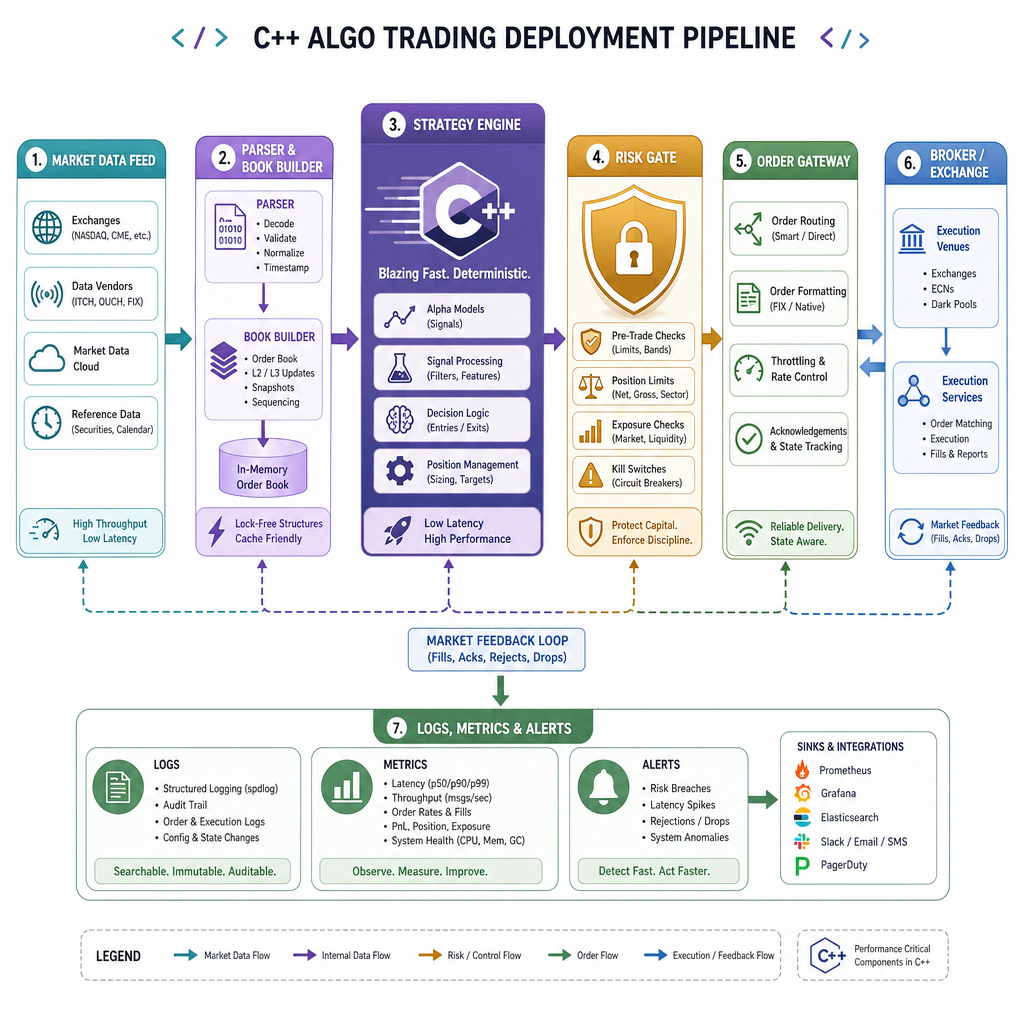
Deployment Architecture
Think in runtime components
Earlier lessons built the pieces: market data acquisition, algorithm decisions, risk checks, and backtest measurement. Deployment connects those pieces into a running system.
A practical first production-style architecture looks like this:
Market Data Feed
      |
      v
Parser / Book Builder
      |
      v
Strategy Engine
      |
      v
Risk Gate
      |
      v
Order Gateway ---> Broker / Exchange
      |
      v
Logs + Metrics + Alerts
Keep each component small and explicit. This makes it easier to test, restart, monitor, and replace parts without rewriting the whole application.
For your first deployment, prefer paper trading or a broker sandbox before live capital. The same code path should run, but orders are simulated or routed to a test environment.
Configuration Modes
Never hardcode deployment behavior
A production app should not require code edits to switch between:
backtestpaperlive
Configuration should control the mode, symbols, risk limits, and endpoints. This reduces accidental live trading and makes runs reproducible, just like you practiced in Setting Up Your C++ Development Environment.
The example below uses command-line arguments to select a deployment mode and prints the resulting behavior.
```cpp
#include <iostream>
#include <string>

struct AppConfig {
    std::string mode = "paper";
    std::string symbol = "AAPL";
    int maxPosition = 100;
};

AppConfig parseArgs(int argc, char* argv[]) {
    AppConfig cfg;
    for (int i = 1; i < argc; ++i) {
        std::string arg = argv[i];
        if (arg == "--mode" && i + 1 < argc) cfg.mode = argv[++i];
        else if (arg == "--symbol" && i + 1 < argc) cfg.symbol = argv[++i];
        else if (arg == "--max-position" && i + 1 < argc) cfg.maxPosition = std::stoi(argv[++i]);
    }
    return cfg;
}

int main(int argc, char* argv[]) {
    AppConfig cfg = parseArgs(argc, argv);

    std::cout << "Starting trading application\n";
    std::cout << "Mode: " << cfg.mode << "\n";
    std::cout << "Symbol: " << cfg.symbol << "\n";
    std::cout << "Max position: " << cfg.maxPosition << "\n";

    if (cfg.mode == "live") {
        std::cout << "LIVE mode selected: extra approvals required before sending orders.\n";
    } else {
        std::cout << "Safe mode: no live orders will be sent.\n";
    }

    return 0;
}
```
Startup Health Checks
Fail before trading, not after
A deployment should verify critical assumptions before it starts processing signals.
Common startup checks:
- Is the market data endpoint configured?
- Is the order gateway endpoint configured?
- Are risk limits positive and reasonable?
- Is the selected mode valid?
- Is the system clock synchronized?
- Can the app write logs?
If a check fails, stop the app loudly. Silent startup errors are dangerous because they can create delayed, partial, or uncontrolled behavior.
```cpp
#include <iostream>
#include <string>
#include <vector>

struct AppConfig {
    std::string mode;
    std::string marketDataEndpoint;
    std::string orderEndpoint;
    int maxPosition;
};

std::vector<std::string> validate(const AppConfig& cfg) {
    std::vector<std::string> errors;

    if (cfg.mode != "paper" && cfg.mode != "live" && cfg.mode != "backtest") {
        errors.push_back("Invalid mode: " + cfg.mode);
    }
    if (cfg.marketDataEndpoint.empty()) {
        errors.push_back("Missing market data endpoint");
    }
    if (cfg.orderEndpoint.empty()) {
        errors.push_back("Missing order endpoint");
    }
    if (cfg.maxPosition <= 0) {
        errors.push_back("Max position must be positive");
    }

    return errors;
}

int main() {
    AppConfig cfg{"paper", "tcp://feed.example:9001", "", 100};

    auto errors = validate(cfg);
    if (!errors.empty()) {
        std::cout << "Startup health check FAILED\n";
        for (const auto& e : errors) {
            std::cout << "- " << e << "\n";
        }
        return 1;
    }

    std::cout << "Startup health check PASSED\n";
    std::cout << "Trading loop can begin.\n";
    return 0;
}
```
Safe Deployment Choice
You have a strategy that performed well in backtests. What is the safest next deployment step before trading real capital?
Observability Matters
If you cannot observe it, you cannot trust it
Low latency C++ systems still need visibility. The trick is to log the right events without flooding the machine.
Useful production logs and metrics:
- Startup configuration summary
- Feed connected / disconnected
- Orders accepted, rejected, cancelled, filled
- Risk rejections
- Strategy decision latency
- End-to-end order path latency
- Heartbeats
For millisecond-sensitive systems, prefer structured logs and counters over random text. In higher-performance versions, logs may be batched or written asynchronously.
```cpp
#include <chrono>
#include <iostream>
#include <string>
#include <thread>

using Clock = std::chrono::steady_clock;

long long microsSince(Clock::time_point start) {
    return std::chrono::duration_cast<std::chrono::microseconds>(Clock::now() - start).count();
}

void logEvent(const std::string& event, const std::string& detail) {
    std::cout << "event=" << event << " detail=\"" << detail << "\"\n";
}

int main() {
    logEvent("startup", "mode=paper symbol=AAPL max_position=100");

    auto start = Clock::now();

    // Simulate strategy decision work.
    std::this_thread::sleep_for(std::chrono::milliseconds(2));

    long long decisionLatency = microsSince(start);
    logEvent("strategy_decision", "side=BUY qty=10 latency_us=" + std::to_string(decisionLatency));

    if (decisionLatency > 5000) {
        logEvent("warning", "decision latency exceeded threshold");
    } else {
        logEvent("latency_ok", "decision latency within threshold");
    }

    return 0;
}
```
Supervision And Recovery
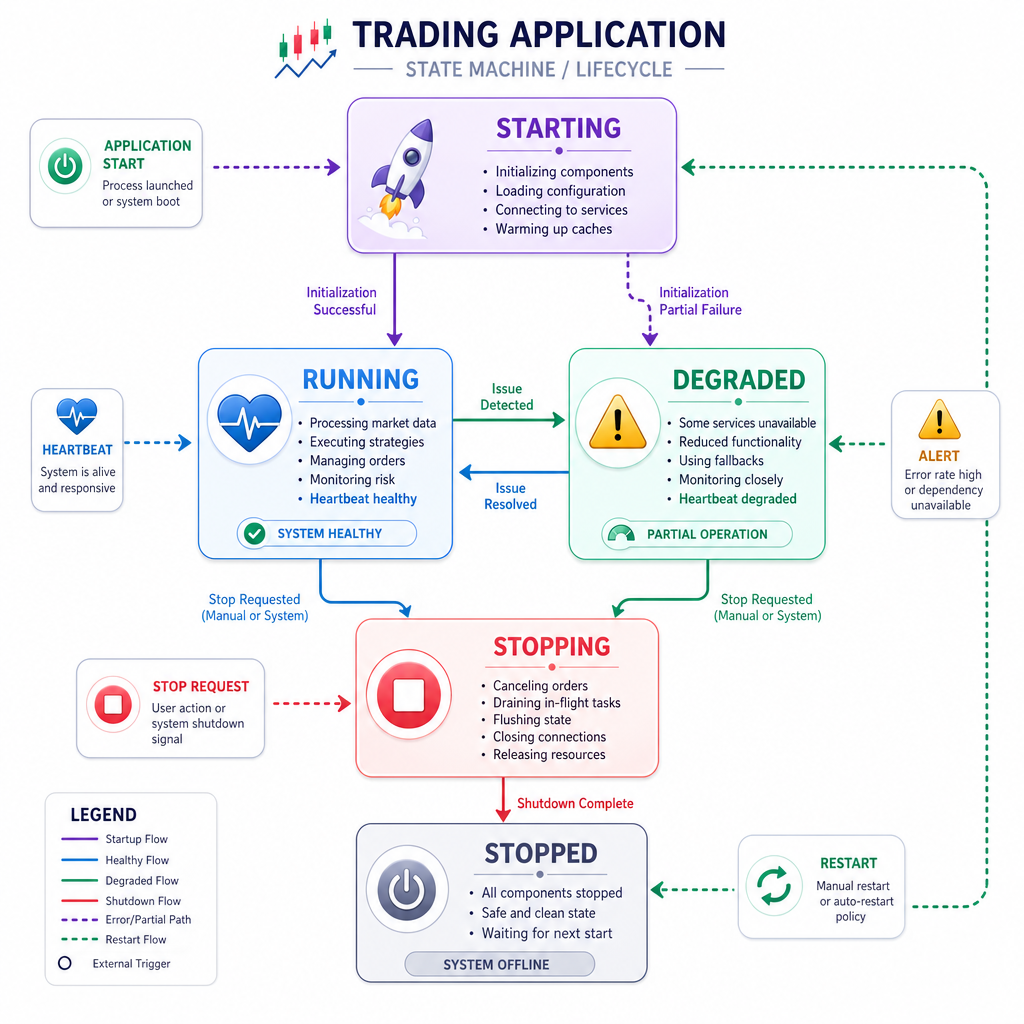
Production apps need a life cycle
Your application should have clear states, not just one endless loop.
STARTING -> RUNNING -> DEGRADED -> STOPPING -> STOPPED
Examples:
- If market data drops, the app may enter
DEGRADEDand stop sending new orders. - If risk configuration is invalid, the app should never enter
RUNNING. - If shutdown is requested, the app should stop cleanly and print final state.
In real deployments, a supervisor such as systemd, Docker, Kubernetes, or a trading platform process manager may restart the application. But your C++ code still needs to handle its own state responsibly.
Graceful Shutdown
Stop deliberately
A trading app should not simply vanish when stopped. It should:
- Stop accepting new signals
- Cancel or reconcile outstanding orders when appropriate
- Print final position and counters
- Flush logs
- Exit with a clear status
The example below simulates a running loop that stops after a few ticks and reports final state.
```cpp
#include <chrono>
#include <iostream>
#include <thread>

struct RuntimeState {
    bool running = true;
    int ticksProcessed = 0;
    int position = 0;
};

int main() {
    RuntimeState state;

    std::cout << "Application started\n";

    while (state.running) {
        ++state.ticksProcessed;
        std::cout << "tick=" << state.ticksProcessed << " processing market data\n";

        if (state.ticksProcessed == 2) {
            state.position += 10;
            std::cout << "simulated fill: position=" << state.position << "\n";
        }

        if (state.ticksProcessed >= 5) {
            std::cout << "shutdown requested\n";
            state.running = false;
        }

        std::this_thread::sleep_for(std::chrono::milliseconds(100));
    }

    std::cout << "Stopping new decisions\n";
    std::cout << "Final ticks processed: " << state.ticksProcessed << "\n";
    std::cout << "Final position: " << state.position << "\n";
    std::cout << "Application stopped cleanly\n";

    return 0;
}
```
Logs Versus Latency
True or false: In a deployed trading application, you should disable all logs because any logging is always more dangerous than having no observability.
Deployment Checklist
Fill in the blank:
Before live trading, run the production code path in a broker sandbox or ______ mode to verify behavior without risking real capital.
Course Wrap Up
You now have the full application path
You started with Introduction to Algorithmic Trading, where we mapped the building blocks of an algo trading system. Then you set up your C++ environment, practiced latency-aware data structures, acquired market data, developed strategy logic, added risk gates, and validated ideas with backtesting.
Deployment ties it together:
- Use explicit modes:
backtest,paper,live - Validate configuration before running
- Keep strategy, risk, and gateway responsibilities separate
- Start in paper mode before live capital
- Monitor latency, order flow, rejects, and risk events
- Shut down cleanly
Your next personal milestone is to assemble a small end-to-end C++ prototype: market data input, strategy decision, risk check, simulated order output, logs, and a deployment mode flag.
Speed matters in markets, but controlled speed is what makes a trading application professional.