Linked Lists
Read at your own pace. Code execution, quizzes, progress tracking, and the AI tutor are available in the interactive view with JavaScript enabled.
Connections Over Slots
From containers to connections
Now that we've covered Arrays and Strings, Sorting and Searching, and Stacks and Queues, you're ready for a new mental model.
Arrays feel like numbered seats:
-
arr[0],arr[1],arr[2] - fast index access
- values live next to each other conceptually
A linked list feels like a chain of trades, orders, or events:
- each value lives in a separate node
- each node points to the next node
- you move by following links
This matters in interviews because linked list problems test whether you can carefully update references without losing data.

Node Mental Model
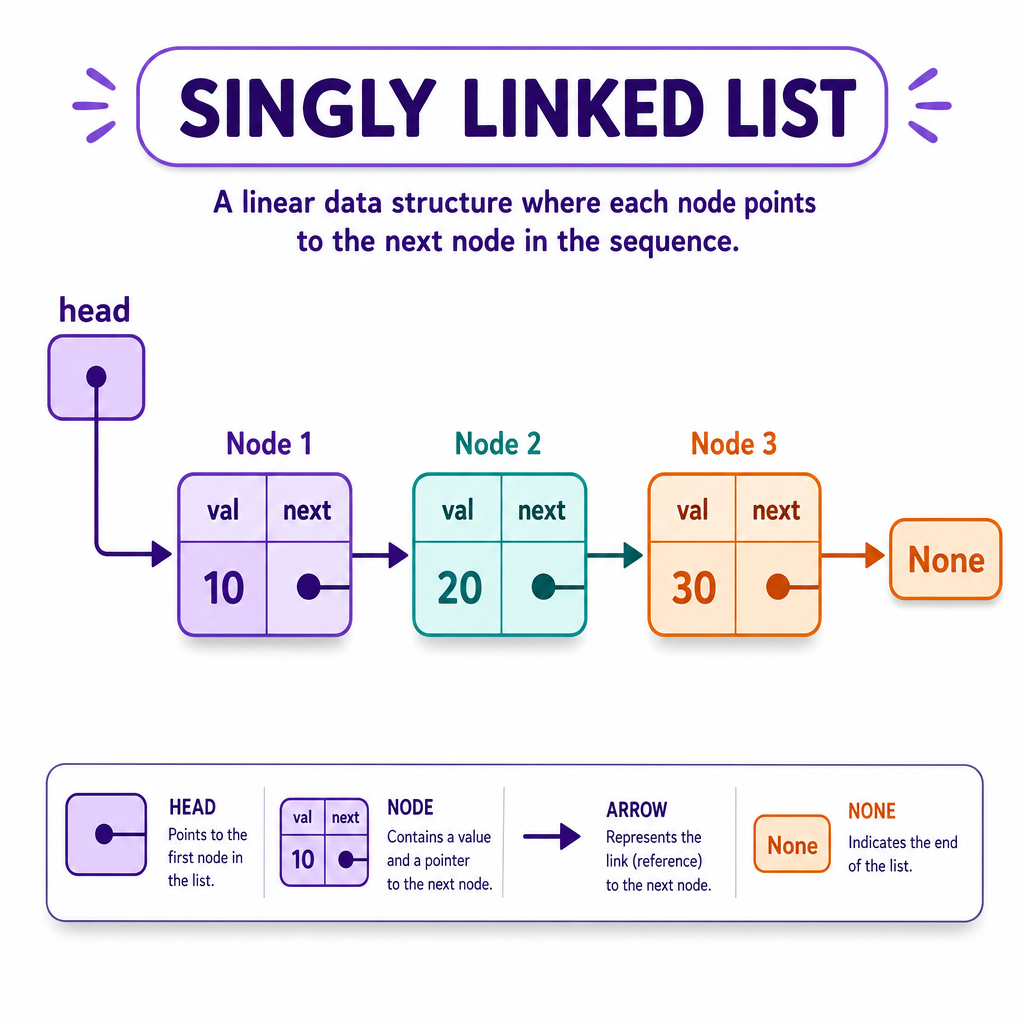
A linked list is made of nodes
A basic singly linked list node stores two things:
-
val: the data -
next: a reference to the next node
ASCII view:
head
 ↓
[10 | next] -> [20 | next] -> [30 | None]
Important idea: head is not the whole list. It is just a reference to the first node.
If you lose head, you lose your starting point.
Build And Traverse
Traversal is the default move
In arrays, you often use an index like i.
In linked lists, you usually use a pointer variable like curr.
The basic pattern is:
- Start at
head - Read the current node
- Move to
curr.next - Stop when
currbecomesNone
This is similar to looping through a queue or stack, but here you control the movement by following explicit links.
```python
class Node:
    def __init__(self, val):
        self.val = val
        self.next = None

# Build: AAPL -> MSFT -> NVDA
head = Node("AAPL")
head.next = Node("MSFT")
head.next.next = Node("NVDA")

# Traverse
curr = head
while curr is not None:
    print(curr.val)
    curr = curr.next
```
Access Cost Check
You have a singly linked list with 1,000 nodes.
What is the time complexity to access the 900th node if you only have head?
Pointer Rewiring
Insert and delete by changing links
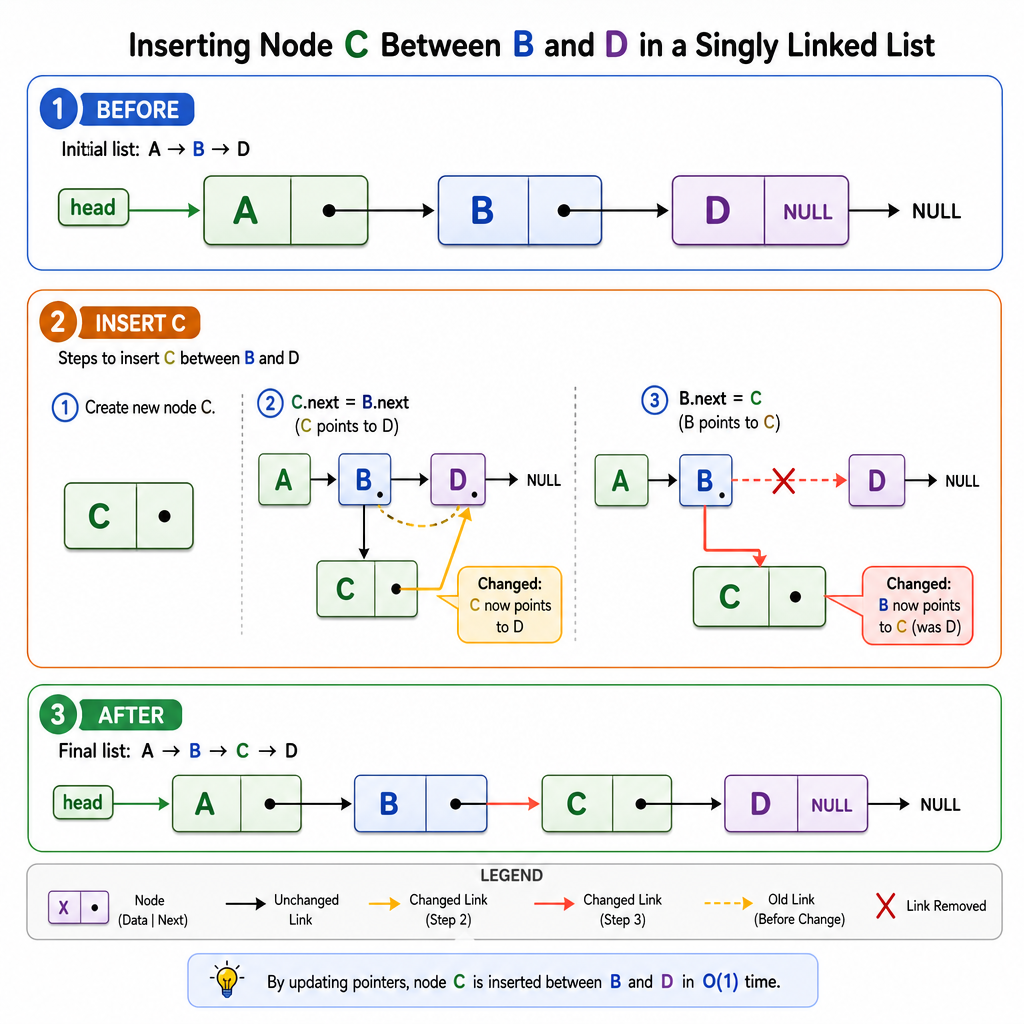
The power of linked lists is not random access. It is rewiring.
Suppose you have:
A -> B -> D
To insert C after B:
A -> B -> C -> D
You do not shift many elements like you might in an array. You change a small number of references.
But there is a catch: you must update links in the right order, or you can accidentally lose part of the list.
Remove With Dummy
Dummy nodes reduce edge-case stress
Interview linked list problems often become tricky when the node to remove is the head.
A common technique is to create a dummy node before the real head:
dummy -> head -> ...
Now removing the first real node looks like removing any other node.
This is not magic. It is just a small setup that makes your pointer logic more consistent.
```python
class Node:
    def __init__(self, val, next=None):
        self.val = val
        self.next = next

def print_list(head):
    values = []
    curr = head
    while curr:
        values.append(str(curr.val))
        curr = curr.next
    print(" -> ".join(values) if values else "empty")

def remove_value(head, target):
    dummy = Node(0, head)
    prev = dummy
    curr = head

    while curr:
        if curr.val == target:
            prev.next = curr.next
            break
        prev = curr
        curr = curr.next

    return dummy.next

# 7 -> 3 -> 9
head = Node(7, Node(3, Node(9)))
print_list(head)

head = remove_value(head, 7)
print_list(head)
```
Deletion Cost
True or false?
In a singly linked list, if you already have a reference to the node before the one you want to delete, the deletion itself can be done in O(1) time.
Fast Slow Pointers
Two pointers, different speeds
You already used two pointers with arrays. Linked lists also have a powerful two-pointer pattern.
A common version:
-
slowmoves one node at a time -
fastmoves two nodes at a time
When fast reaches the end, slow is near the middle.
This pattern is useful because linked lists do not have instant access to len(list) // 2 by index.
```python
class Node:
    def __init__(self, val, next=None):
        self.val = val
        self.next = next

def middle_value(head):
    slow = head
    fast = head

    while fast and fast.next:
        slow = slow.next
        fast = fast.next.next

    return slow.val

# 10 -> 20 -> 30 -> 40 -> 50
head = Node(10, Node(20, Node(30, Node(40, Node(50)))))
print(middle_value(head))
```
Traversal Blank
Fill in the blank.
In a singly linked list traversal, after processing the current node, you usually move forward with:
curr = ______
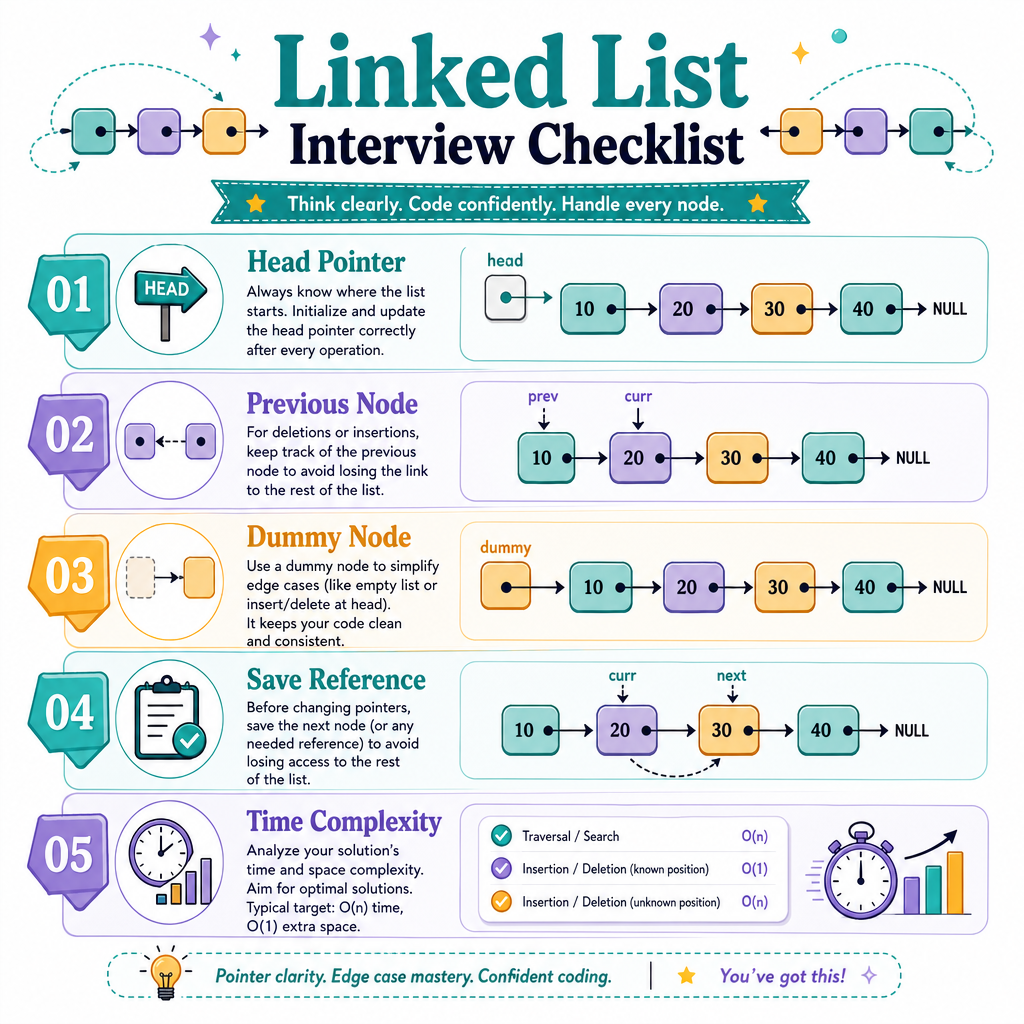
Interview Checklist
How to think in interviews
When you see a linked list problem, slow down and ask:
-
Do I have the head?
- Most operations start there.
-
Do I need the previous node?
- Deletion in a singly linked list often needs
prev.
- Deletion in a singly linked list often needs
-
Could the head change?
- If yes, consider a dummy node.
-
Am I losing the rest of the list?
- Save references before rewiring.
-
What is the cost?
- Traversal: O(n)
- Insert/delete after a known node: O(1)
- Search by value: O(n)
Linked lists are your bridge from simple containers to connected structures. Next, that idea of connected nodes will become even more important when you study trees.