Python Best Practices and Optimization Techniques
Read at your own pace. Code execution, quizzes, progress tracking, and the AI tutor are available in the interactive view with JavaScript enabled.
Optimize With Purpose
Why this lesson matters
Now that you've completed Intermediate Python for Google Interviews, Advanced Algorithms and Data Structures, and the System Design Primer, you have the main tools: Python syntax, algorithmic patterns, and high-level design thinking.
This lesson connects them into a practical interview skill: writing Python that is clear, correct, and efficient under pressure.
For a part-time coder preparing for Google-style interviews, the goal is not to memorize clever tricks. The goal is to build a repeatable habit:
- Start with correctness.
- Make the code readable.
- Use the right data structures.
- Optimize only where constraints demand it.
- Explain tradeoffs clearly.
Next lesson, you'll apply this in mock interview practice. Here, we sharpen the code quality itself.

Readable Beats Clever
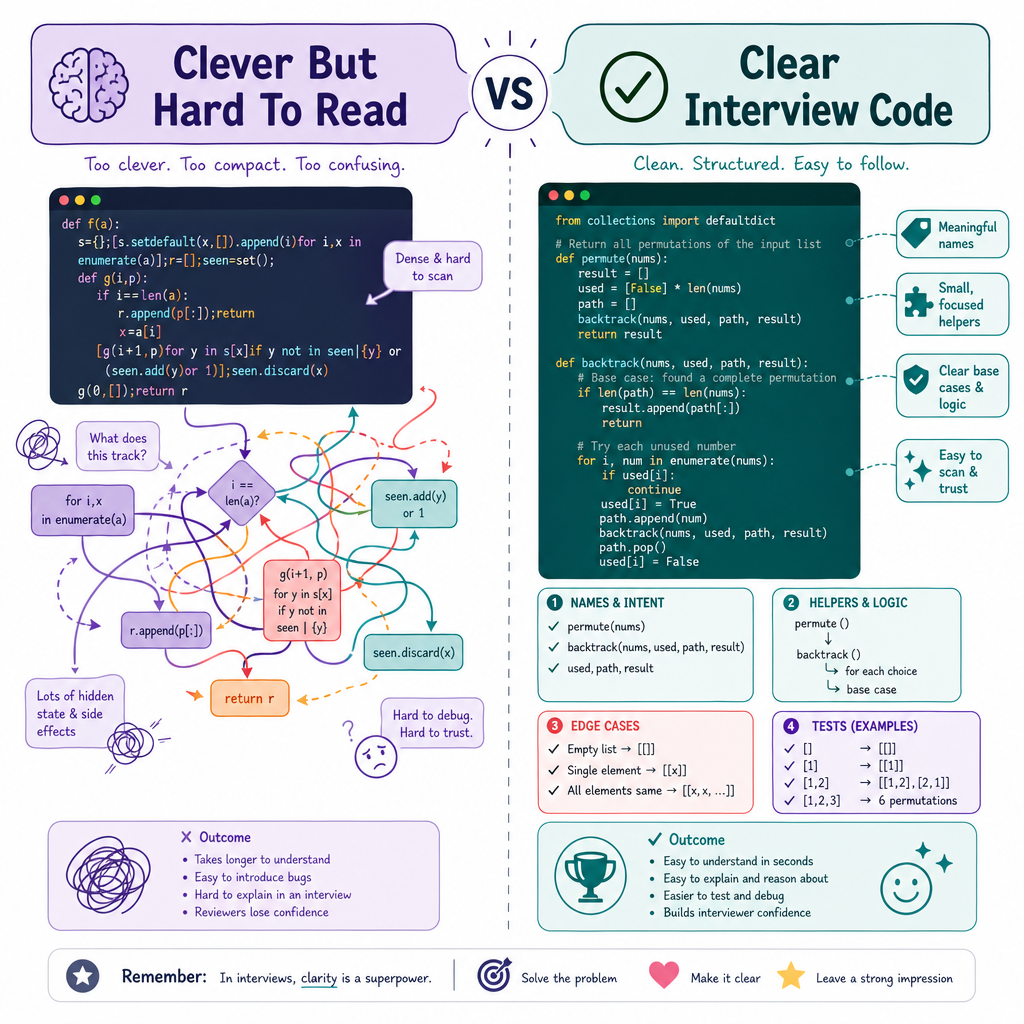
Interview code has two audiences
Your code must satisfy the computer, but it also must satisfy the interviewer.
In Google-style interviews, readability is part of performance because the interviewer is evaluating how you think, debug, and communicate.
Prefer:
- Descriptive variable names
- Small helper functions when logic repeats
- Straight-line control flow when possible
- Explicit edge-case handling
- Comments that explain why, not every line of what
Avoid:
- Over-compressed one-liners
- Hidden mutation unless intentional
- Premature micro-optimizations
- Names like
x,tmp,reseverywhere
A good rule: if you cannot explain a line quickly while coding live, simplify it.
Best First Move
You solve a problem correctly, but your first version may be too slow for large inputs. What is the best next step in an interview?
Measure Before Guessing
Profiling mindset
In interviews, you usually estimate complexity mentally. But during practice, measuring small snippets helps build intuition.
Use timing to compare implementation choices only after you understand the Big-O behavior. A faster constant factor cannot rescue the wrong algorithmic class.
Example: membership checks in a list versus a set. This connects directly to the hashing patterns you practiced in Intermediate Python for Google Interviews.
```python
import time

nums = list(range(200_000))
num_set = set(nums)
target = 199_999

start = time.perf_counter()
print(target in nums)
print("list lookup seconds:", round(time.perf_counter() - start, 6))

start = time.perf_counter()
print(target in num_set)
print("set lookup seconds:", round(time.perf_counter() - start, 6))
```
Lookup Complexity
For Python dict and set, average-case membership lookup is usually ____.
Choose Structures Intentionally
Data structure choice is optimization
Most interview optimizations are not tiny syntax changes. They come from choosing the right structure for the operation you repeat most.
Quick mental map:
- Need fast membership? Use
set. - Need key-to-value mapping? Use
dict. - Need counts? Use
collections.Counter. - Need queue behavior? Use
collections.deque. - Need priority ordering? Use
heapq, as seen in Advanced Algorithms and Data Structures.
The key question is: What operation happens most often?
If that operation is expensive, the whole solution becomes expensive.
```python
from collections import Counter, deque

words = ["tree", "graph", "tree", "heap", "graph", "tree"]
counts = Counter(words)
print("most common:", counts.most_common(2))

queue = deque(["start"])
queue.append("next")
print("popped:", queue.popleft())
print("remaining:", list(queue))
```
Micro Before Macro
True or false: In interview problem solving, improving variable names and replacing a few loops with comprehensions is usually more important than reducing an algorithm from O(n²) to O(n log n).
Pythonic Without Magic
Use Python features that clarify intent
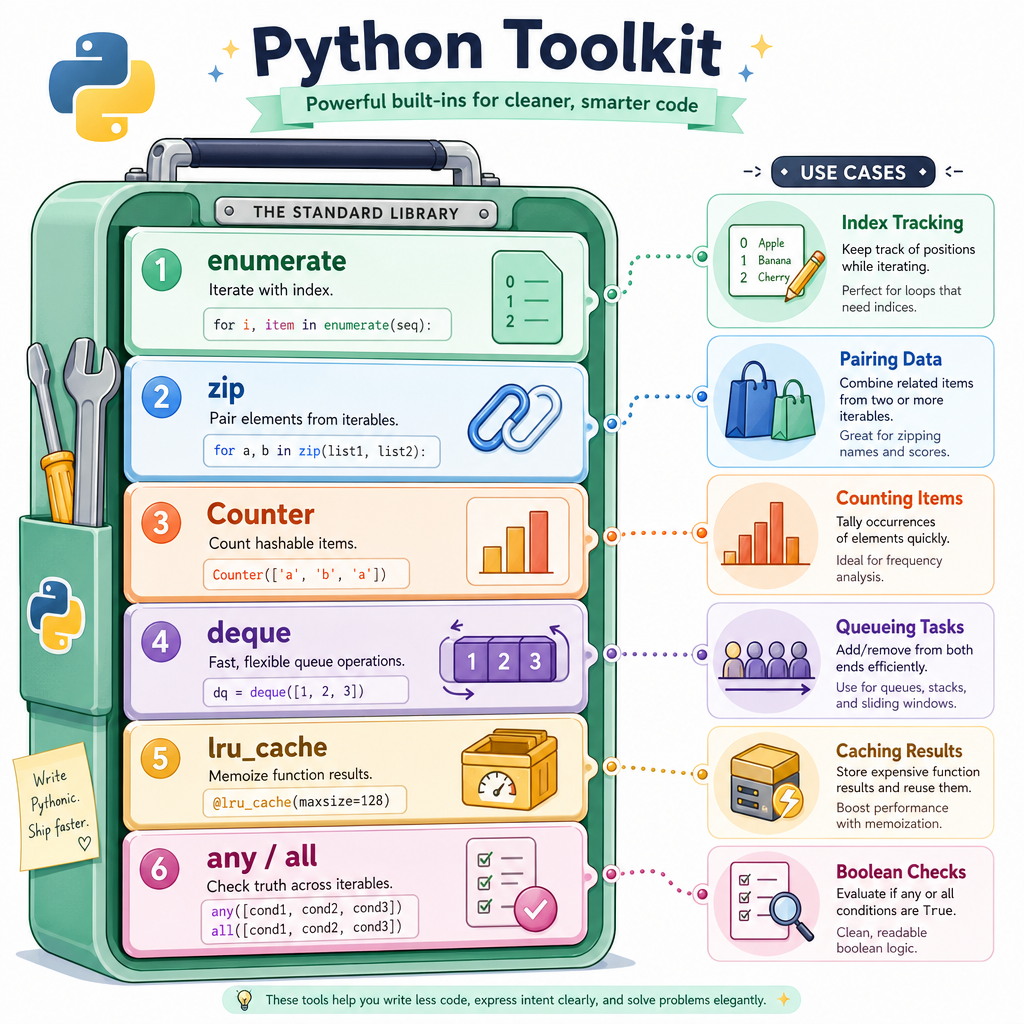
Python has powerful tools, but in interviews they should make your reasoning easier to follow.
Good interview-friendly tools:
-
enumerate()when you need index and value -
zip()when walking two sequences together -
defaultdictorCounterfor grouping/counting -
any()andall()for clear boolean checks -
lru_cachefor memoization when the recursive state is obvious
Be careful with features that hide too much. If a built-in makes your solution shorter but harder to explain, it may not help.
Your target is not maximum cleverness. It is transparent correctness.
```python
from functools import lru_cache

@lru_cache(None)
def ways_to_climb(steps):
    if steps <= 1:
        return 1
    return ways_to_climb(steps - 1) + ways_to_climb(steps - 2)

for n in range(6):
    print(n, ways_to_climb(n))

print("cache info:", ways_to_climb.cache_info())
```
Optimization Checklist
A calm checklist for live coding
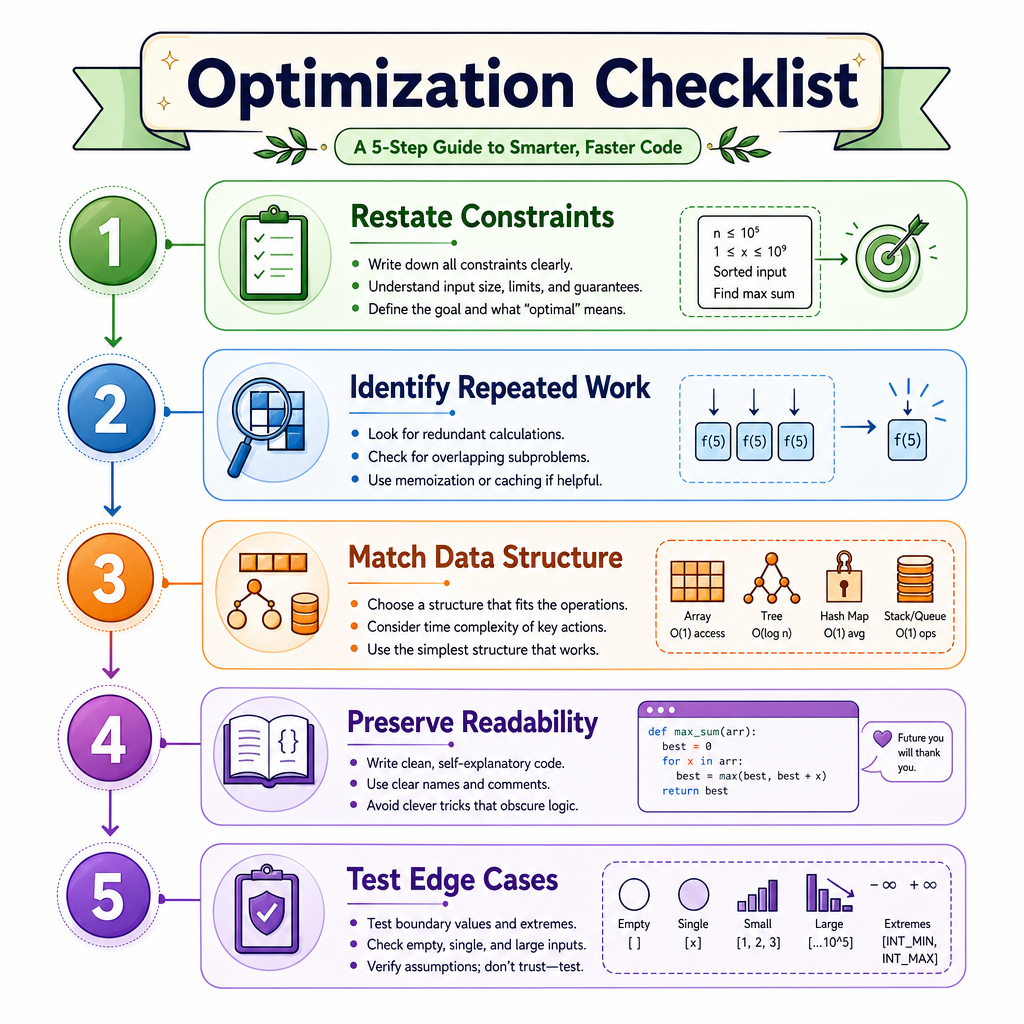
When your solution is correct but needs improvement, walk through this sequence:
1. Restate constraints
Ask yourself: how large can n get? Is input sorted? Are duplicates possible?
2. Identify repeated work
Look for nested loops, repeated scans, repeated sorting, or repeated recursion.
3. Match operation to structure
If you repeatedly check existence, use a set. If you repeatedly need min or max, consider a heap. If you repeatedly compute overlapping states, consider memoization.
4. Preserve readability
After optimizing, rename variables and simplify branches. Interviewers value code they can verify.
5. Test edge cases
Try empty input, one item, duplicates, negative numbers, and large values when relevant.
This is the bridge from knowing algorithms to performing well in interviews.
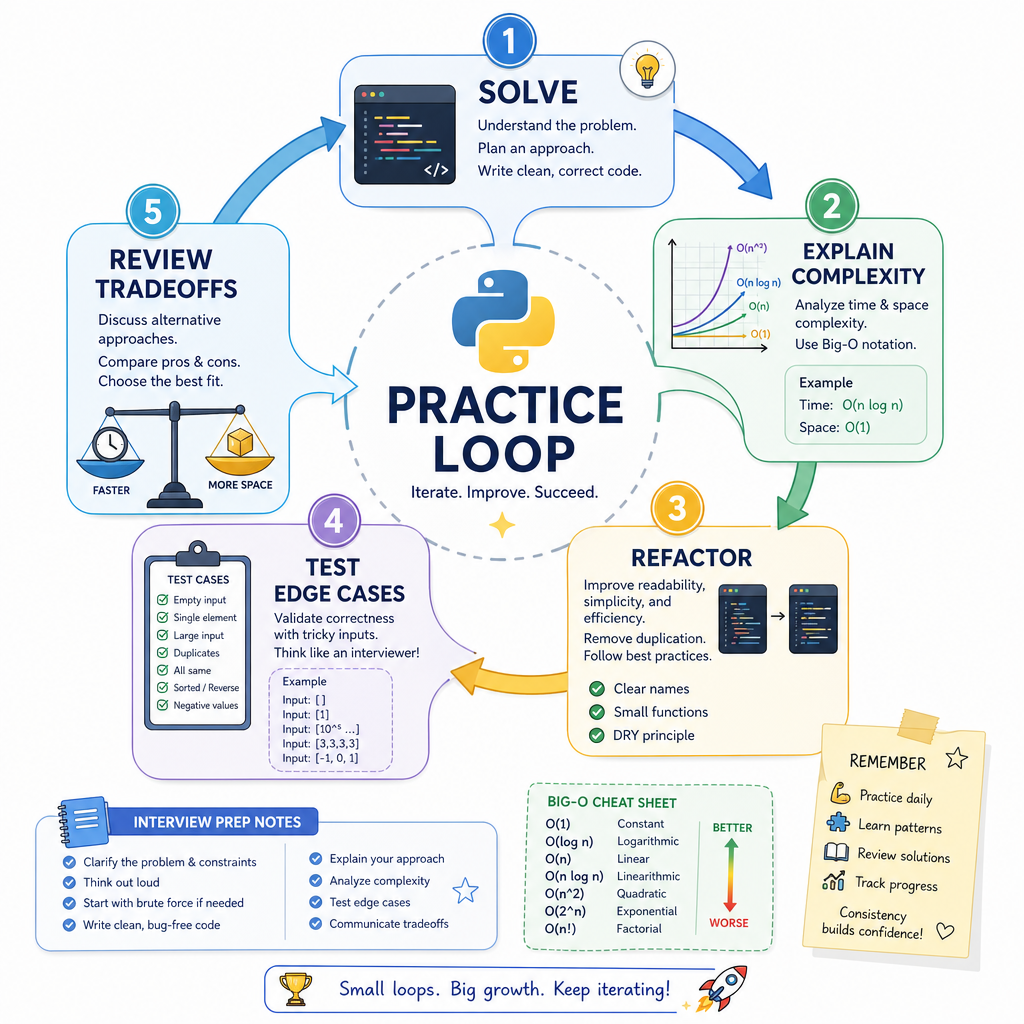
Practice Loop
Your daily practice target
For the rest of the course, do not just ask, "Did my code pass?"
Ask:
- Can I explain my complexity clearly?
- Did I choose data structures intentionally?
- Is my code readable enough for someone else to trace?
- Did I handle edge cases without overcomplicating the solution?
- Can I improve one thing without breaking correctness?
This lesson completes the coding-quality layer of the course. In Mock Interview Practice and Problem-Solving Strategies, you will combine this with communication, timing, and pressure management.