Real-time Data Handling with WebSockets in R
Read at your own pace. Code execution, quizzes, progress tracking, and the AI tutor are available in the interactive view with JavaScript enabled.
From API To Stream
Why this lesson matters
In Fetching OHLC Data from APIs, you built the habit of treating market data as a contract: timestamp, symbol, open, high, low, close, volume, and a guarded schema.
Now we move from requesting historical chunks to listening continuously.
A WebSocket is how your live system receives market events as they happen:
Historical API:  ask -> receive page -> stop
WebSocket:       connect -> receive event -> receive event -> ...
In this lesson, we focus only on handling the live stream safely:
- connect to a stream
- parse each incoming message
- normalize it into your internal row format
- handle disconnects
- keep a small live buffer ready for later calculations
Next lesson, that buffer becomes the input for 30-minute and 60-minute timeframe calculations.

WebSocket Mental Model
Think in events, not files
A live trading pipeline is not primarily a table. It is a sequence of events.
Each incoming WebSocket message should answer:
- What symbol is this about?
- When did the event happen?
- What market value changed?
- Can I trust the shape of this message?
- Where does it go next?
A clean mental model is:
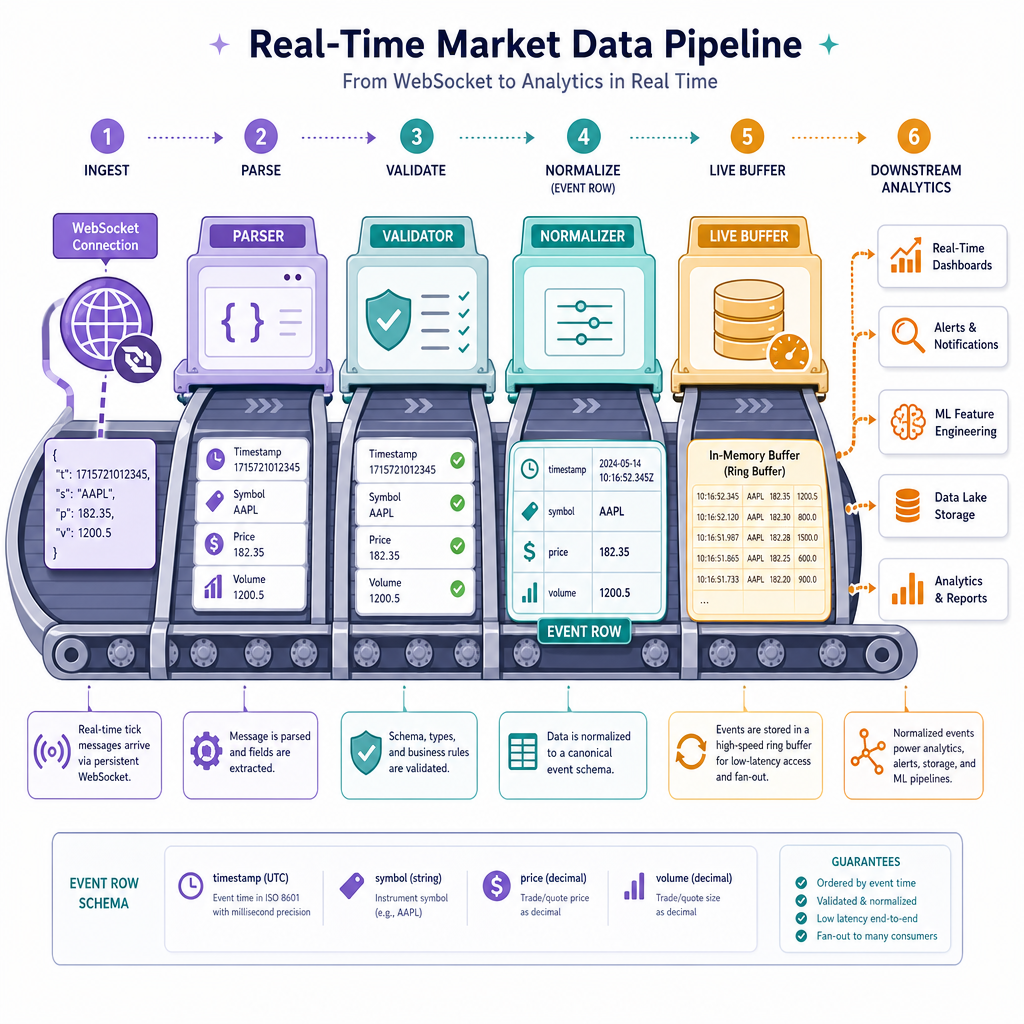
WebSocket message
      |
      v
parser / validator
      |
      v
normalized event row
      |
      v
live buffer / state store
      |
      v
future timeframe + model pipeline
This is similar to the One Row Concept from the introduction, but now each row arrives one at a time and must be handled immediately.
Normalize Each Event
The first job: convert raw messages into stable rows
Real WebSocket vendors do not all send the same shape. One source may send p for price, another may send price. One may use milliseconds, another ISO timestamps.
Do not let vendor-specific fields leak through your whole system.
Instead, convert every valid incoming message into your internal event shape:
ts | symbol | price | volume | source_seq
Below is a small executable simulation. It pretends that raw WebSocket messages are arriving as JSON strings, then normalizes them.
```python
import json
from datetime import datetime, timezone

raw_messages = [
    '{"type":"trade","symbol":"AAPL","ts_ms":1710000000000,"p":189.42,"v":100,"seq":1}',
    '{"type":"trade","symbol":"AAPL","ts_ms":1710000001000,"p":189.47,"v":50,"seq":2}',
    '{"type":"heartbeat","ts_ms":1710000002000}',
    '{"type":"trade","symbol":"MSFT","ts_ms":1710000003000,"p":402.10,"v":25,"seq":3}'
]

def normalize_message(raw):
    msg = json.loads(raw)

    # Ignore operational messages that are not market data.
    if msg.get('type') != 'trade':
        return None

    required = ['symbol', 'ts_ms', 'p', 'v', 'seq']
    missing = [field for field in required if field not in msg]
    if missing:
        raise ValueError(f'Missing fields: {missing}')

    ts = datetime.fromtimestamp(msg['ts_ms'] / 1000, tz=timezone.utc)

    return {
        'ts': ts.isoformat(),
        'symbol': msg['symbol'],
        'price': float(msg['p']),
        'volume': int(msg['v']),
        'source_seq': int(msg['seq'])
    }

for raw in raw_messages:
    row = normalize_message(raw)
    if row is not None:
        print(row)
```
Stream Contract Check
A vendor WebSocket sends this raw message:
{"type":"trade","symbol":"AAPL","p":189.42,"v":100}
Your internal stream contract requires:
ts | symbol | price | volume | source_seq
What is the safest next step?
Reconnect Without Panic
Live connections fail
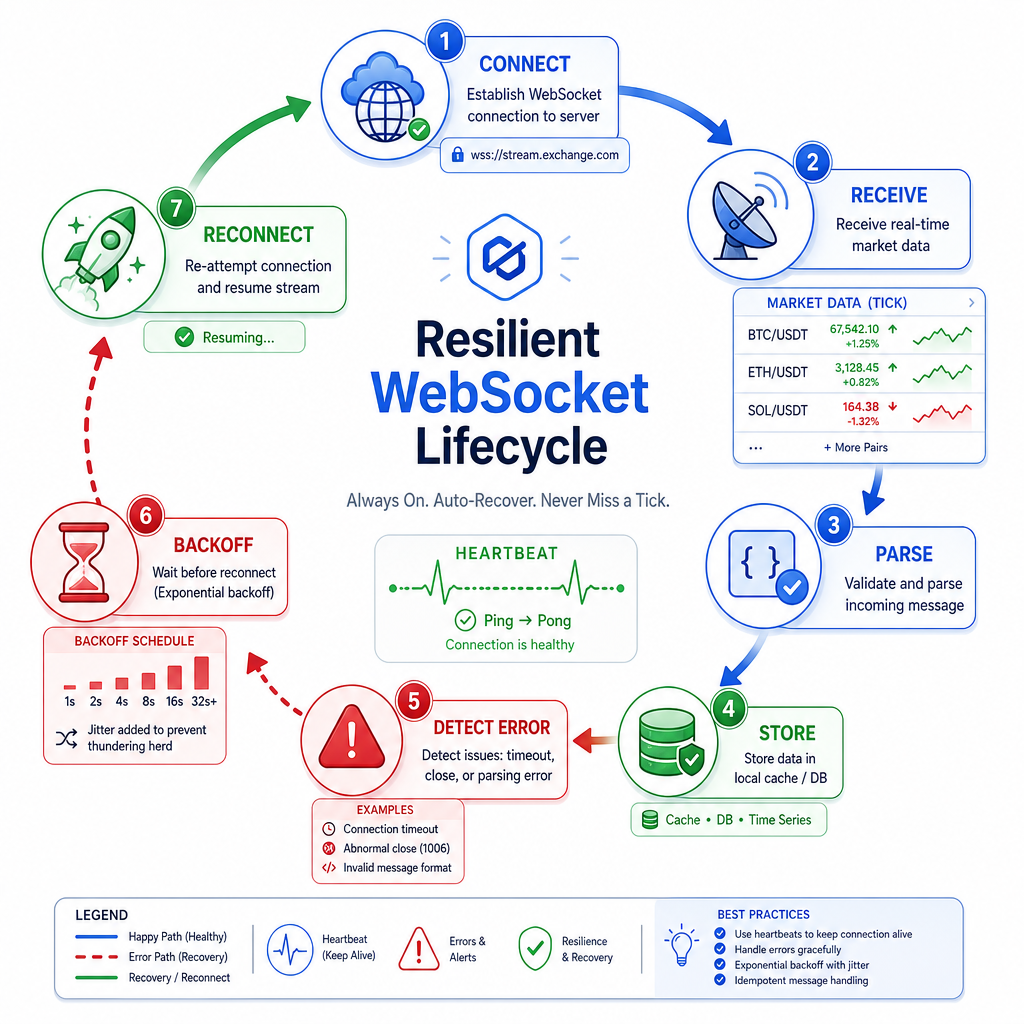
A WebSocket is persistent, but not permanent.
Your handler should expect:
- dropped network connections
- heartbeat messages
- malformed payloads
- duplicate messages
- temporary vendor outages
The goal is not to prevent all failure. The goal is to make failure boring:
connect -> read -> parse -> store
   ^                 |
   |                 v
 reconnect <---- handle error
The example below simulates a stream that disconnects once, then reconnects and continues.
```python
import asyncio

class FakeWebSocket:
    def __init__(self, attempt):
        self.attempt = attempt
        self.messages = [
            'trade:AAPL:189.42',
            'trade:AAPL:189.45'
        ]

    async def __aiter__(self):
        for i, message in enumerate(self.messages):
            await asyncio.sleep(0.05)
            if self.attempt == 1 and i == 1:
                raise ConnectionError('simulated disconnect')
            yield message

async def consume_with_reconnect(max_attempts=3):
    attempt = 1
    while attempt <= max_attempts:
        print(f'connecting attempt={attempt}')
        try:
            async for message in FakeWebSocket(attempt):
                print('received:', message)
            print('stream ended normally')
            return
        except ConnectionError as err:
            print('warning:', err)
            attempt += 1
            await asyncio.sleep(0.1)

    print('gave up after too many reconnect attempts')

asyncio.run(consume_with_reconnect())
```
Heartbeat Messages
True or false:
Heartbeat or ping messages from a WebSocket should usually be treated as market price updates and inserted into the same event buffer as trades.
Maintain Live State
Store only what the next stage needs
A live system needs a small, clear state layer between the socket and the analytics.
For now, keep:
- a recent event buffer per symbol
- the latest sequence number per symbol
- duplicate protection
- a snapshot method for downstream consumers
Do not calculate the 30-minute or 60-minute moving averages yet. That belongs to the next lesson. Here, the job is to preserve clean second-level events in arrival order.
```python
from collections import defaultdict, deque

class LiveEventStore:
    def __init__(self, max_events_per_symbol=3):
        self.events = defaultdict(lambda: deque(maxlen=max_events_per_symbol))
        self.last_seq = {}

    def add(self, row):
        symbol = row['symbol']
        seq = row['source_seq']

        if symbol in self.last_seq and seq <= self.last_seq[symbol]:
            print(f'duplicate_or_old ignored: {symbol} seq={seq}')
            return False

        self.events[symbol].append(row)
        self.last_seq[symbol] = seq
        print(f'stored: {symbol} seq={seq} price={row["price"]}')
        return True

    def snapshot(self, symbol):
        return list(self.events[symbol])

store = LiveEventStore(max_events_per_symbol=2)

rows = [
    {'ts':'2024-03-09T16:00:00Z','symbol':'AAPL','price':189.42,'volume':100,'source_seq':1},
    {'ts':'2024-03-09T16:00:01Z','symbol':'AAPL','price':189.47,'volume':50,'source_seq':2},
    {'ts':'2024-03-09T16:00:01Z','symbol':'AAPL','price':189.47,'volume':50,'source_seq':2},
    {'ts':'2024-03-09T16:00:02Z','symbol':'AAPL','price':189.51,'volume':80,'source_seq':3}
]

for row in rows:
    store.add(row)

print('snapshot:', store.snapshot('AAPL'))
```
Buffer Blank
Fill in the blank:
A live WebSocket handler should convert raw vendor messages into a stable internal event ______ before storing them for downstream calculations.
Keep Work Separated
Do not train, aggregate, and reconnect in the same function
A common live-trading mistake is putting everything inside one giant callback:
on_message() {
  parse JSON
  update candles
  calculate indicators
  train model
  predict
  send order
  reconnect somehow
}
That becomes hard to test and dangerous in real time.
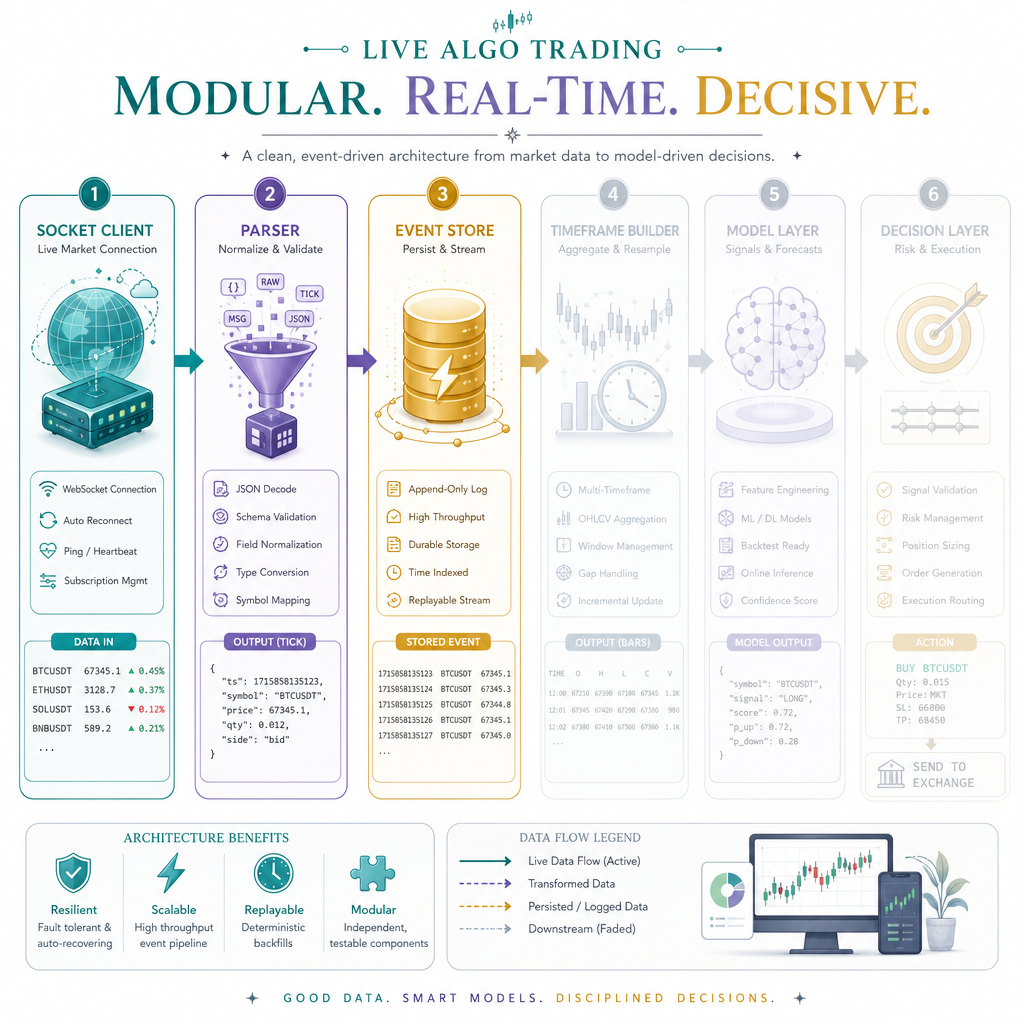
Prefer separation:
socket client -> parser -> event store -> timeframe builder -> model layer -> decision layer
This lesson owns only the first three boxes. That boundary matters because live systems fail at the seams: malformed data, delayed data, dropped sockets, and duplicate events.
Boundary Question
In this lesson's architecture, what should the WebSocket handling layer be responsible for?