C++ for Real-World Applications
Read at your own pace. Code execution, quizzes, progress tracking, and the AI tutor are available in the interactive view with JavaScript enabled.
From Syntax To Systems
The final step: applying C++
You have now moved through the core C++ journey:
- Introduction to C++ gave you the compiled-performance mindset.
- Data Types and Variables showed how values map to memory.
- Functions And Recursion gave programs structure.
- OOP Basics and OOP Advanced helped model larger systems.
- File Handling, Exception Handling, STL, and Modern C++ gave you practical tools.
Now we connect those ideas to real-world domains where C++ is chosen deliberately: high-performance services, AI infrastructure, and financial simulations.
The theme of this lesson is simple:
C++ is not just about writing code that works. It is about writing code whose speed, memory use, reliability, and architecture matter.

Optimization Mindset
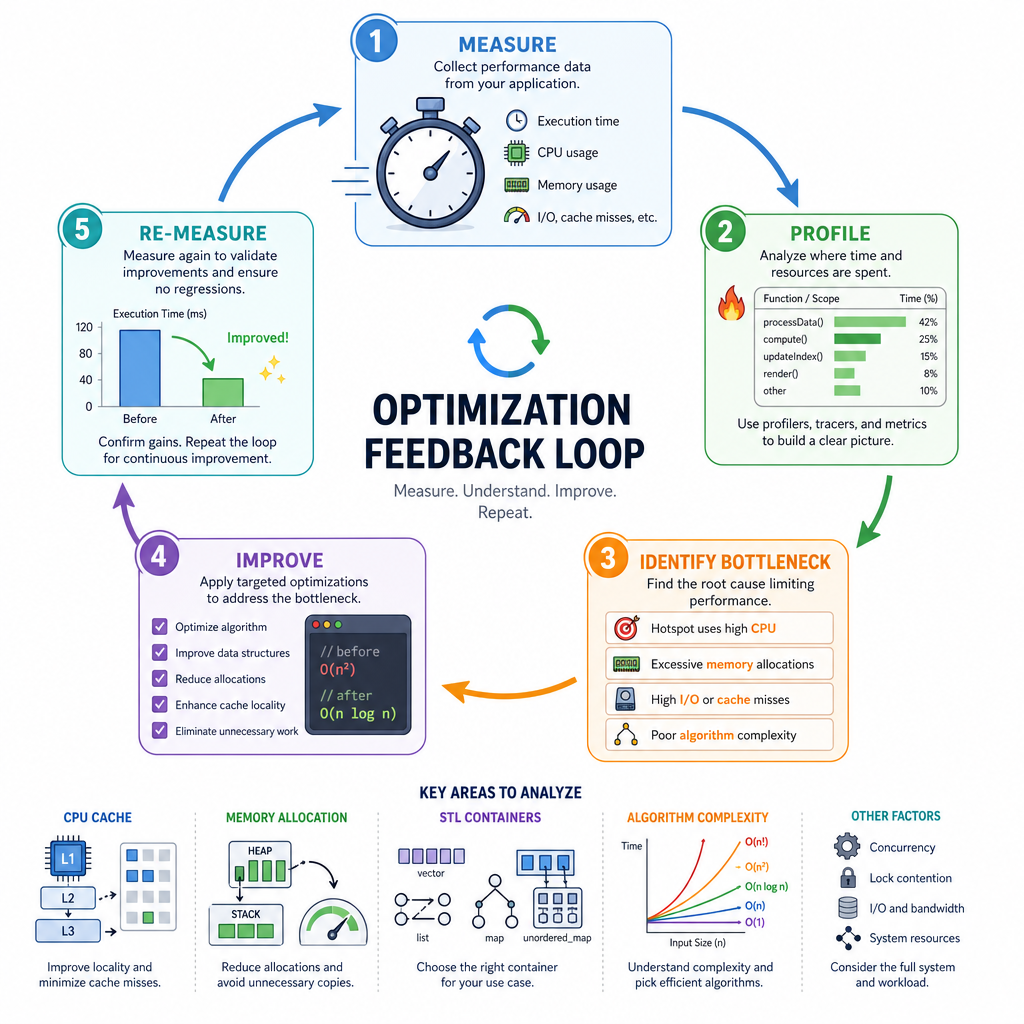
Optimization is measurement plus intent
Coming from web development, you may be used to optimizing network calls, database queries, bundle sizes, or rendering behavior. In C++, the same principle applies: guessing is dangerous.
Good optimization usually follows this loop:
Measure → Find bottleneck → Change one thing → Measure again
Common C++ optimization levers include:
-
Choosing the right STL container from Introduction to STL
-
vectorfor cache-friendly sequential data -
unordered_mapfor average-case fast lookup -
set/mapwhen sorted order matters
-
- Avoiding unnecessary copies using references, moves, and ownership ideas from Modern C++
- Reducing allocations by reserving capacity or reusing memory
- Improving locality by keeping related data close together in memory
- Using better algorithms, often more important than micro-optimizing syntax
A fast program is usually not made fast by one clever trick. It is made fast by many design choices that respect how data moves through memory and CPU caches.
Reserve Saves Work
Small choices can avoid repeated allocation
When a vector grows, it may need to allocate a larger memory block and move existing elements. If you already know roughly how many elements you will store, reserve() tells the vector to prepare enough space up front.
This does not change the final result. It changes the amount of work needed to get there.
This example compares pushing values into a vector with and without reserve(). The exact timing depends on your machine, but the shape of the lesson is what matters: fewer reallocations usually means less overhead.
```cpp
#include <chrono>
#include <iostream>
#include <vector>

long long buildWithoutReserve(int n) {
    std::vector<int> values;

    auto start = std::chrono::high_resolution_clock::now();
    for (int i = 0; i < n; ++i) {
        values.push_back(i);
    }
    auto end = std::chrono::high_resolution_clock::now();

    return std::chrono::duration_cast<std::chrono::microseconds>(end - start).count();
}

long long buildWithReserve(int n) {
    std::vector<int> values;
    values.reserve(n);

    auto start = std::chrono::high_resolution_clock::now();
    for (int i = 0; i < n; ++i) {
        values.push_back(i);
    }
    auto end = std::chrono::high_resolution_clock::now();

    return std::chrono::duration_cast<std::chrono::microseconds>(end - start).count();
}

int main() {
    const int n = 1'000'000;

    std::cout << "Without reserve: " << buildWithoutReserve(n) << " microseconds\n";
    std::cout << "With reserve:    " << buildWithReserve(n) << " microseconds\n";
    std::cout << "Both vectors store the same data; reserve changes the allocation strategy.\n";

    return 0;
}
```
Optimization Check
You are building a large std::vector and you already know it will contain about 500,000 elements.
What is the most appropriate first improvement?
C++ In AI
Why AI systems often use C++
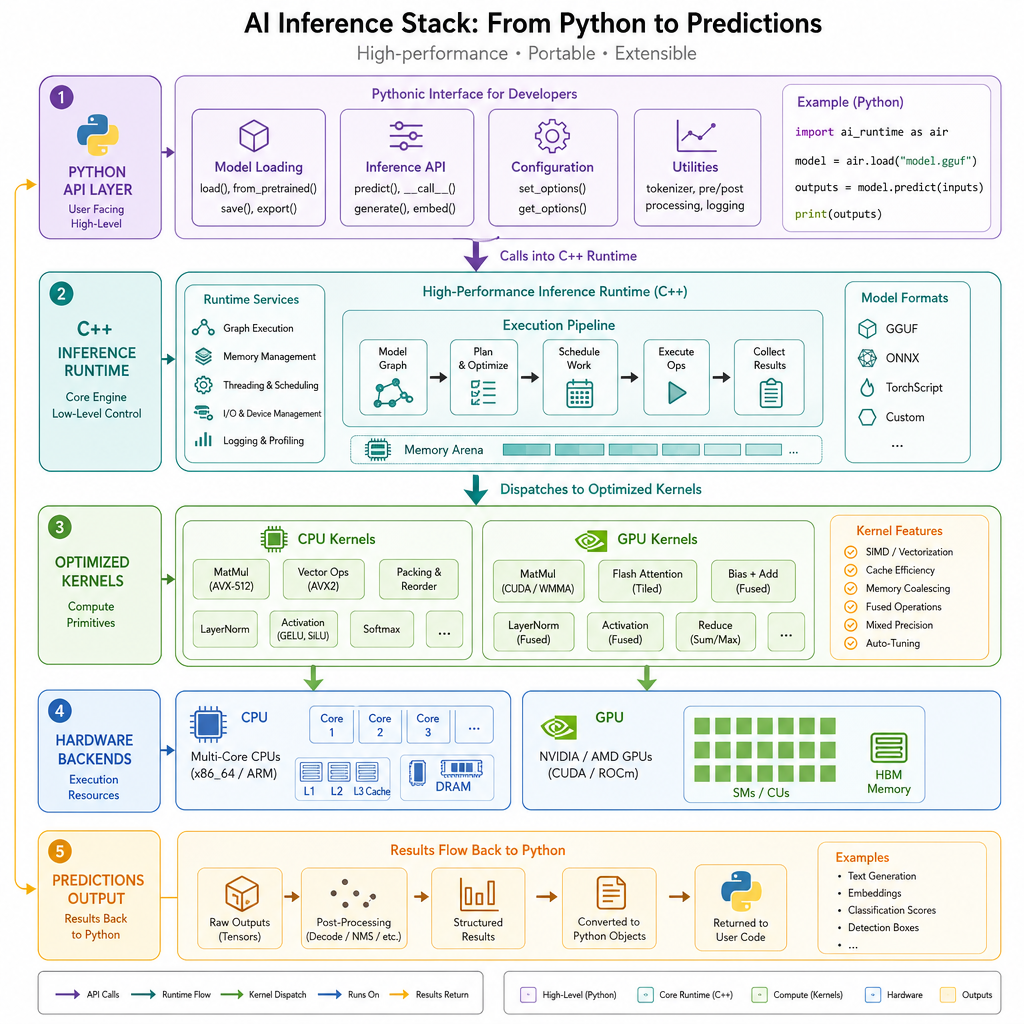
Many AI workflows are written in Python at the top level because Python is convenient for experimentation. But underneath, performance-critical pieces are often implemented in C++ or CUDA-backed native code.
C++ commonly appears in:
- Tensor libraries and numerical kernels
- Inference engines for running trained models efficiently
- Robotics and embedded AI, where latency matters
- Game AI, simulation, pathfinding, and decision systems
- Production model serving, where throughput and memory control are critical
A useful mental model:
Python notebook or API
        ↓
C++ tensor/runtime engine
        ↓
CPU/GPU optimized kernels
        ↓
Fast inference result
Your earlier lessons matter here. Data types control precision, functions shape reusable kernels, STL containers organize data, and Modern C++ ownership helps prevent expensive or unsafe resource handling.
Tiny Inference Kernel
A small model, C++ style
At the heart of many machine learning models is repeated numeric computation. A neural network layer, recommendation score, or linear classifier may boil down to vector math.
Here is a tiny standalone example: a weighted score plus bias. It is not a full ML framework, but it resembles the inner calculation many systems perform millions of times.
Notice the practical C++ habits:
-
std::vector<double>stores numeric data. - A function creates a clear computation contract.
- We validate dimensions before calculating.
- The program prints a prediction-like result.
```cpp
#include <iostream>
#include <stdexcept>
#include <vector>

double weightedScore(const std::vector<double>& features,
                     const std::vector<double>& weights,
                     double bias) {
    if (features.size() != weights.size()) {
        throw std::invalid_argument("features and weights must have the same length");
    }

    double score = bias;
    for (std::size_t i = 0; i < features.size(); ++i) {
        score += features[i] * weights[i];
    }
    return score;
}

int main() {
    std::vector<double> userFeatures = {0.9, 0.2, 0.7};
    std::vector<double> modelWeights = {1.5, -0.4, 0.8};
    double bias = -0.3;

    try {
        double score = weightedScore(userFeatures, modelWeights, bias);
        std::cout << "Model score: " << score << "\n";
        std::cout << "Prediction: " << (score > 1.0 ? "positive" : "negative") << "\n";
    } catch (const std::exception& ex) {
        std::cout << "Error: " << ex.what() << "\n";
    }

    return 0;
}
```
AI Runtime Reality
True or false:
Even when an AI project is controlled from Python, C++ may still be used underneath for performance-critical tensor operations and inference runtimes.
C++ In Finance
Finance cares about speed and correctness
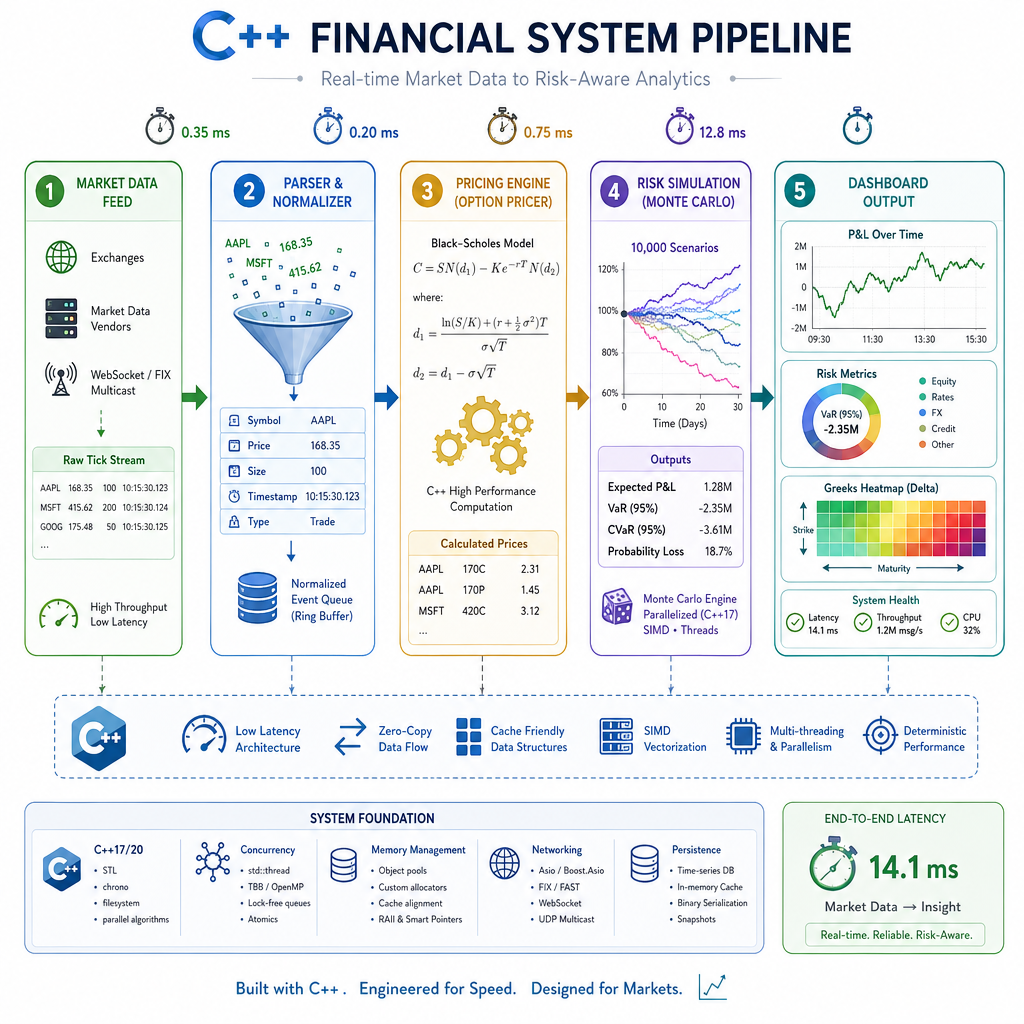
Financial systems often process huge amounts of data under strict timing and reliability constraints. C++ is common because it offers high performance with precise control over memory and execution.
Real-world finance use cases include:
- Market data processing: ingesting and normalizing fast streams of prices
- Risk calculations: estimating exposure across many positions
- Pricing models: valuing options, bonds, and derivatives
- Monte Carlo simulations: running thousands or millions of random scenarios
- Low-latency trading systems: reacting quickly to market events
But speed alone is not enough. The earlier Exception Handling lesson matters because financial software must also handle bad input, missing files, network issues, and invalid assumptions carefully.
In finance, a wrong fast answer is worse than a slow correct one.
Monte Carlo Sketch
Simulations turn uncertainty into estimates
A Monte Carlo simulation runs many random trials and averages the result. In finance, this is often used to estimate outcomes when the future is uncertain.
The following example is intentionally simplified. It estimates the expected payoff of a call option:
payoff = max(finalPrice - strikePrice, 0)
A real pricing engine would use more advanced math, market assumptions, and validation. But this captures why C++ is attractive: many independent numeric trials can be run quickly.
```cpp
#include <algorithm>
#include <iostream>
#include <random>

int main() {
    const int trials = 100000;
    const double startPrice = 100.0;
    const double strikePrice = 105.0;
    const double averageMove = 0.03;
    const double volatility = 0.20;

    std::mt19937 generator(42); // fixed seed for repeatable output
    std::normal_distribution<double> yearlyReturn(averageMove, volatility);

    double totalPayoff = 0.0;

    for (int i = 0; i < trials; ++i) {
        double simulatedReturn = yearlyReturn(generator);
        double finalPrice = startPrice * (1.0 + simulatedReturn);
        double payoff = std::max(finalPrice - strikePrice, 0.0);
        totalPayoff += payoff;
    }

    double estimatedPayoff = totalPayoff / trials;

    std::cout << "Estimated average payoff: " << estimatedPayoff << "\n";
    std::cout << "Trials run: " << trials << "\n";

    return 0;
}
```
Memory Preparation
Fill in the blank:
When you know a std::vector will grow to a large size, calling _____() can reduce repeated reallocations before many push_back() operations.
Course Wrap
You now have the C++ map
This course started with a simple compiled program and ended with real-world systems. Along the way, you built the vocabulary needed to understand professional C++ code:
- Types and variables: how data is represented
- Control flow: how programs make decisions and repeat work
- Functions and recursion: how logic becomes reusable
- Classes and polymorphism: how systems model behavior
- Files and exceptions: how programs interact with the outside world safely
- STL: how C++ gives you powerful containers and algorithms
- Modern C++: how ownership, lambdas, and safer idioms shape current code
- Real-world applications: why performance, reliability, and architecture matter
Where to go next:
- Build a small command-line tool that reads a file and summarizes data.
- Implement classic algorithms using STL containers.
- Write a tiny simulation, game engine component, or model scoring service.
- Study profiling tools so optimization is based on evidence.
The main lesson: C++ rewards precision. You now know enough to read, write, question, and improve C++ programs with intent.